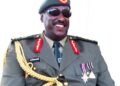









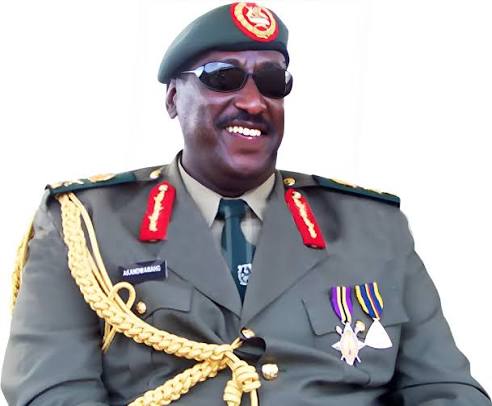
The Chief Coordinator of Operation Wealth Creation (OWC) and Presidential Adviser on Defence and Security, Gen. Caleb Akandwanaho, popularly known as Gen. Salim Saleh, has transformed his Kiroma Heritage Farm in Sembabule Sub-county, Nakasongola District, into a School of Research aimed at advancing evidence-based national development.

According to Saleh’s office, the General Caleb Akandwanaho School of Research has been established to preserve, document and share decades of development research and practical experience accumulated by Gen. Saleh
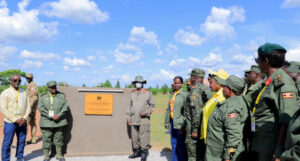 President Yoweri Museveni together with other government senior officials during the laying of foundation stone for the building of the General Caleb Akandwanaho School of Research and the Walter Rodney Block on day six of the NRM Party Leader’s retreat at the National Leadership Institute in Kyankwanzi on April 13, 2026
Saleh’s spokesperson, Dismas Okoo, said the initiative builds on the School of Research concept introduced at the National Leadership Institute (NALI) in Kyankwanzi, where President Yoweri Museveni recently launched the Walter Rodney Block during an engagement with newly elected Members of Parliament and ministers.
Okoo explained that while the Kyankwanzi initiative laid the foundation, the practical research and knowledge-sharing activities are now being conducted at Kiroma Heritage Farm.
He noted that the school was created to make years of tested research readily available to policymakers, government technocrats, development partners and researchers, reducing duplication of studies and promoting informed decision-making.
“This is not a policy-making institution,” Okoo said. “Its role is to provide credible, evidence-based information that supports government planning and development. Researchers and practitioners can access existing findings instead of repeating work that has already been done.”
Among the institution’s key research areas is land governance, a subject Gen. Saleh has reportedly studied since publishing a paper on food security in 1996. According to Okoo, the research highlights land as a critical factor in achieving sustainable food security, agricultural transformation, industrialisation and wealth creation.
The school has also developed and tested an Alternative Land Dispute Resolution model designed to reduce lengthy court battles over land ownership. Okoo revealed that more than 300 of the over 530 land disputes identified in Nakasongola District have already been resolved through the mediation approach, demonstrating its potential for wider application across the country.
Beyond research, the institution promotes dialogue and consensus-building by providing a platform where stakeholders with differing views can exchange ideas, evaluate evidence and develop practical solutions for national development.
Kiroma Heritage Farm has evolved from an agricultural demonstration site into a multi-purpose centre supporting commercial farming, livestock production, youth mentorship, enterprise development, investment promotion and policy discussions. The facility regularly hosts government officials, diplomats, private sector leaders, entrepreneurs, farmers and researchers seeking practical lessons in wealth creation and rural transformation.
The farm has also become a showcase for industrial innovation, featuring machine fabrication and value-addition technologies that support Uganda’s manufacturing agenda.
Dr. Fred Muhumuza, a lecturer at Makerere University’s College of Business and Management Sciences, welcomed the transformation, saying it would help bridge the gap between academic research and practical development by providing a platform where ideas can be tested in real-world settings.